

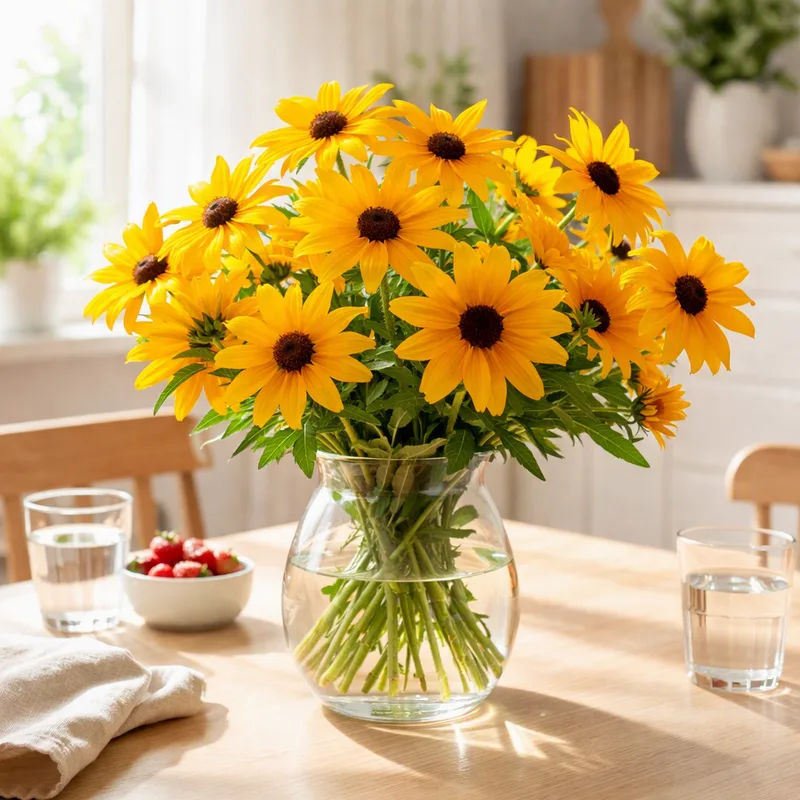


Where the coneflower comes from
All Rudbeckia species originate in North America. As daisy-family plants they are called coneflowers because of the raised dark centre. Most are perennials, a few are annual or biennial, and they typically bloom in mid to late summer. For us in the southern hemisphere, that translates to roughly January to March.
Which one to choose
Rudbeckia hirta, the black-eyed Susan, is commonly raised from seed as a short-lived plant, reaching 30 to 100 cm. Rudbeckia fulgida, particularly the cultivar Goldsturm, is a reliable perennial for borders. Echinacea is another coneflower and a different genus. Rudbeckia has yellow to orange petals, while Echinacea is usually purple-pink.
Growing in Australia
Rudbeckia likes full sun, decent soil and regular water in summer. It copes with warm conditions better than many cold-climate perennials, but humid weather can bring mildew, so give plants airflow. Gardeners in Melbourne, Sydney and Canberra can plant in spring, from September to November. In Brisbane and the subtropics, start seed in autumn or early spring.
- Pinch young plants for bushier growth.
- Remove old flowers to prolong the display, and leave the last few to ripen if you want seed.
- Divide clumps of perennial types every few years in autumn.
A good Australian companion is the native golden everlasting paper daisy, which also loves sun.
In the vase and around pets
Cut stems last about a week. Rudbeckia is absent from the ASPCA toxic list; still, plants are not snacks, so ring a vet after a big nibble.